Data Residency Enforcement for Cross-Border HRIS Pipelines
Employee data leaks through logging, backups, and AI inference, not just storage.
Employee data residency compliance in HR technology no longer hinges on picking the right cloud region and calling it done. Payroll numbers, benefits elections, performance scores, biometric login data, and AI-scored hiring outcomes each travel through different systems, hit different regulatory triggers, and often break residency in places nobody on the HR team is watching. The failures cluster in the parts of the pipeline nobody diagrams: log shipping, backup jobs, embedding services, support tooling. Fixing that takes layered controls across every one of those surfaces, and most HR teams are only building for one or two of them.
More than 30 countries updated payroll, employment tax, or mandatory benefit rules between 2025 and 2026 alone, and payroll data now sits at the crossing point of HR, finance, IT, and legal compliance all at once. Governments want more granular payroll detail than they used to ask for, and at the same time they're tightening the rules on how that same data has to be stored, accessed, and secured. More scrutiny plus stricter handling rules turns this into a systems problem, not a policy memo problem, and treating it as the latter is the mistake that appears in audits a year later.
The regulatory obligations that directly reach HR data flows, jurisdiction by jurisdiction
Data localization law is now in effect in more than 100 jurisdictions, and the count of countries with some form of data protection law grew from about 80 in 2015 to over 160 by 2026. Roughly one in three organizations reported a data sovereignty incident in the past twelve months. None of that is abstract for HR technology. Employee records rank among the most consistently regulated categories of personal data anywhere in the world, and treating them like ordinary application data is how companies end up on the wrong side of a fine.
The EU carries the highest stakes, mostly because two regimes now apply to the same data at once. Under GDPR, moving HR data out of the EU requires Standard Contractual Clauses, Binding Corporate Rules, or an adequacy decision, and each option demands an explicit, auditable legal basis for every single flow, not a blanket policy covering the whole company. Penalties run up to 7% of global annual turnover, and enforcement isn't theoretical: regulators issued roughly €1.2 billion in GDPR fines in 2025 alone, with the cumulative total since 2018 now past €7.1 billion.
Layering the EU AI Act on top of that gives HR technology a second exposure point. Full enforcement for high-risk systems under Annex III got pushed back to December 2, 2027, after the Digital Omnibus on AI took effect on July 27, 2026. Algorithmic hiring tools and workforce analytics platforms are widely expected to be in that high-risk bucket anyway, which stacks penalties up to €35 million or 7% of global turnover on top of GDPR exposure. An HRIS feeding employee records into an AI-based hiring or performance tool has to satisfy GDPR's transfer rules and the AI Act's documentation, bias-detection, and governance requirements at the same time. Two separate compliance tracks, running in parallel, not one.
The EU-US Data Privacy Framework complicates things further. It's still valid in 2026 and it survived a challenge at the EU General Court in September 2025 (the Latombe case), but that ruling is now under appeal to the Court of Justice of the EU, the same court that struck down both of the framework's predecessors. A June 2026 US Supreme Court ruling in Trump v. Slaughter, which held that the President can remove commissioners of a national trade oversight agency at will, cuts into the independence of the oversight body the framework leans on structurally. Anyone building a pipeline that routes EU employee data to US cloud infrastructure should treat SCCs, not the framework, as the working legal basis today. Betting on the framework surviving its next legal test is a bet the last two frameworks lost.
India's Digital Personal Data Protection Act adds its own calendar. The DPDP Rules were formally notified on November 14, 2025, and the 18-month compliance window puts the hard deadline at May 2027. A second phase brings in consent-manager registration, which changes how HRIS platforms have to record employee consent for processing. A third phase brings security safeguards, mandatory breach notification, retention and erasure limits, obligations for organizations handling children's data, and cross-border transfer controls, all landing together. Penalties for significant violations run up to ₹250 crore, roughly $30 million. Any Indian employee record replicating to a global HR hub needs a documented lawful basis for that transfer and a defined erasure schedule in place well before phase three hits, not after.
Where residency fails: the overlooked surfaces in a typical HRIS pipeline
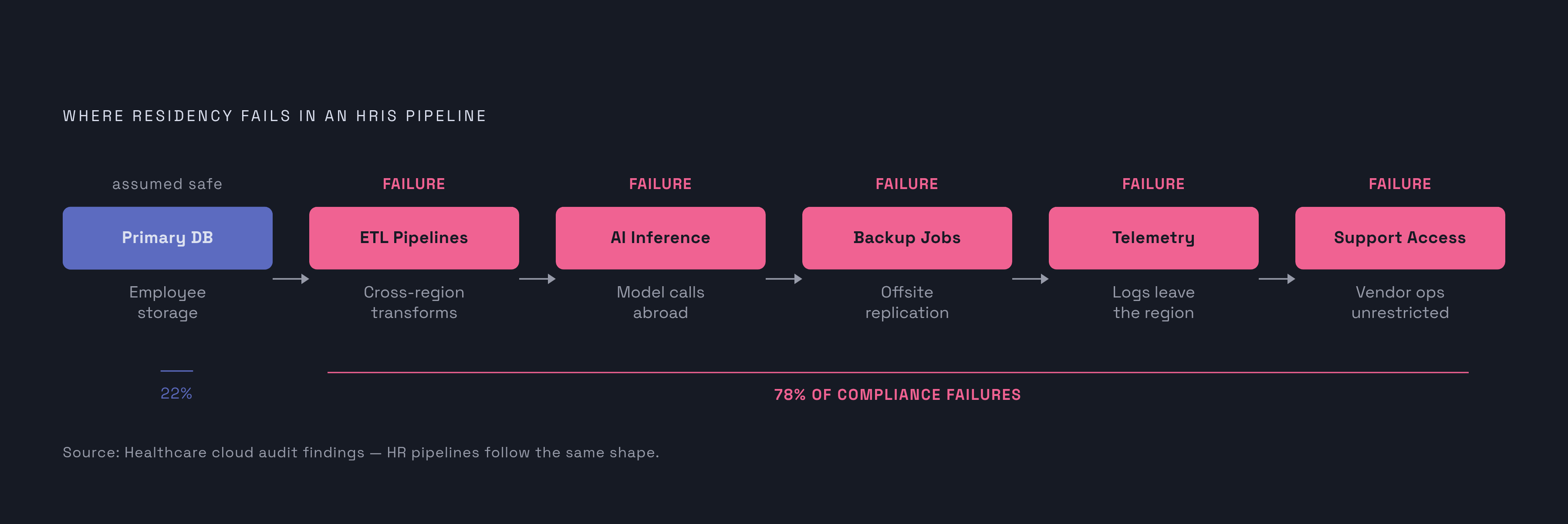
Residency rarely breaks in the primary database. It breaks in the backup nobody audited, the AI inference call nobody mapped, the ETL job that quietly moved data across a border to save on compute, the support session where an engineer pulled a record from the wrong region to debug a ticket. In healthcare cloud audits, 78% of compliance failures traced back to components other than storage: ETL pipelines, AI inference, backups, support access. HR data pipelines follow the same shape, and treating storage as the whole problem is how the other four get missed.
Telemetry is the most common gap, and it's common precisely because it's invisible to the team that owns the application. A payroll workload can run entirely inside the correct region and still ship its logs to a centralized observability platform sitting somewhere else. If those logs capture request payloads, error traces, or session context, and they almost always do, they're carrying employee identifiers and field values that count as personal data under GDPR and similar regimes. The workload passes the audit. The logging layer fails it, silently, and nobody checks the logging layer because it isn't the system anyone thinks of as "HR data."
AI inference brings a newer version of the same problem. A document might sit in the correct region while the embedding service or vector database that indexes it runs somewhere else entirely, or replicates that index elsewhere for latency reasons. Embeddings, inference outputs, and evaluation samples derived from regulated documents can themselves carry the regulatory weight of the source data, so bolting on an AI feature without revisiting the data map quietly widens residency exposure. Every call to a hosted large language model sends employee data to that provider's infrastructure for active processing, and that counts as an international transfer under GDPR Chapter V every time the feature runs, not just the first time.
Anthropic, OpenAI, and Google all offer EU-resident inference endpoints as of 2026, so the inference call itself is usually solvable. Fine-tuning pipelines are a different story: they're less mature, and organizations often discover, later than they'd like, that model customization routes through US-only infrastructure regardless of where inference happens. The residency surface for a generative AI feature spans multiple distinct components: the model API, the retrieval or vector store, observability, prompt caching, feedback and fine-tuning data, and vendor support telemetry. An HRIS AI feature, whether it's screening resumes or summarizing performance reviews, touches components across all of these layers, and most teams have not mapped them systematically.
Layered technical controls that make residency enforcement provable across each surface
Residency means every place a byte of employee data rests, even for a few milliseconds, across every component of the system that touches it, including the database, the logs, the backup, the model call, and the support console. Designing for that means giving each surface a deliberate regional answer instead of inheriting whatever a vendor sets as its default, which is usually wherever compute happens to be cheapest that quarter.
Region pinning is the foundation, but most teams stop at region pinning, wrongly assuming it covers the rest. A model call or a storage write executes against a specific regional endpoint, and the provider commits, contractually and technically, that input and output bytes stay inside that region. Bedrock, Vertex AI, and Azure OpenAI all offer regional selection as of 2026, but support for specific models and features varies by region in ways that aren't obvious until a production deploy fails. Pinning the region is step one. Confirming that the specific model variant and feature set are actually available there, before committing production traffic to it, is the step teams skip. Region pinning also only solves one of the six AI surfaces: it says nothing about backups, ETL jobs, or support access. That gap is why it can't be the whole strategy, and any residency plan that stops at region pinning is not a residency plan.
Edge redaction closes a different gap. Stripping personally identifiable fields (national ID numbers, payroll figures, performance scores) at the edge, before a payload ever crosses into a model API's region, removes an entire category of residency question before it can arise. That kind of redaction can run inside a CDN worker or a regional API gateway in milliseconds, with a placeholder standing in for the real value throughout downstream processing. For HR data specifically, this means the fields carrying the highest regulatory weight never leave their home region in the first place, no matter what happens downstream in analytics or AI processing.
None of these controls work alone. Region pinning without edge redaction still exposes sensitive fields to whichever service processes them next. Redaction without auditing the observability and backup layers still leaves logs and disaster-recovery replicas as unmonitored exit points nobody watches. Provable residency treats storage, logging, backups, AI inference, and support access as five separate problems that happen to share one data set, with a specific, checkable answer built for each. Anything short of that is a policy document, not a control.